
Cognitive Processing Therapy (CPT) for PTSD for Trauma /Crisis: Practitioner Certification

- Description
- Curriculum
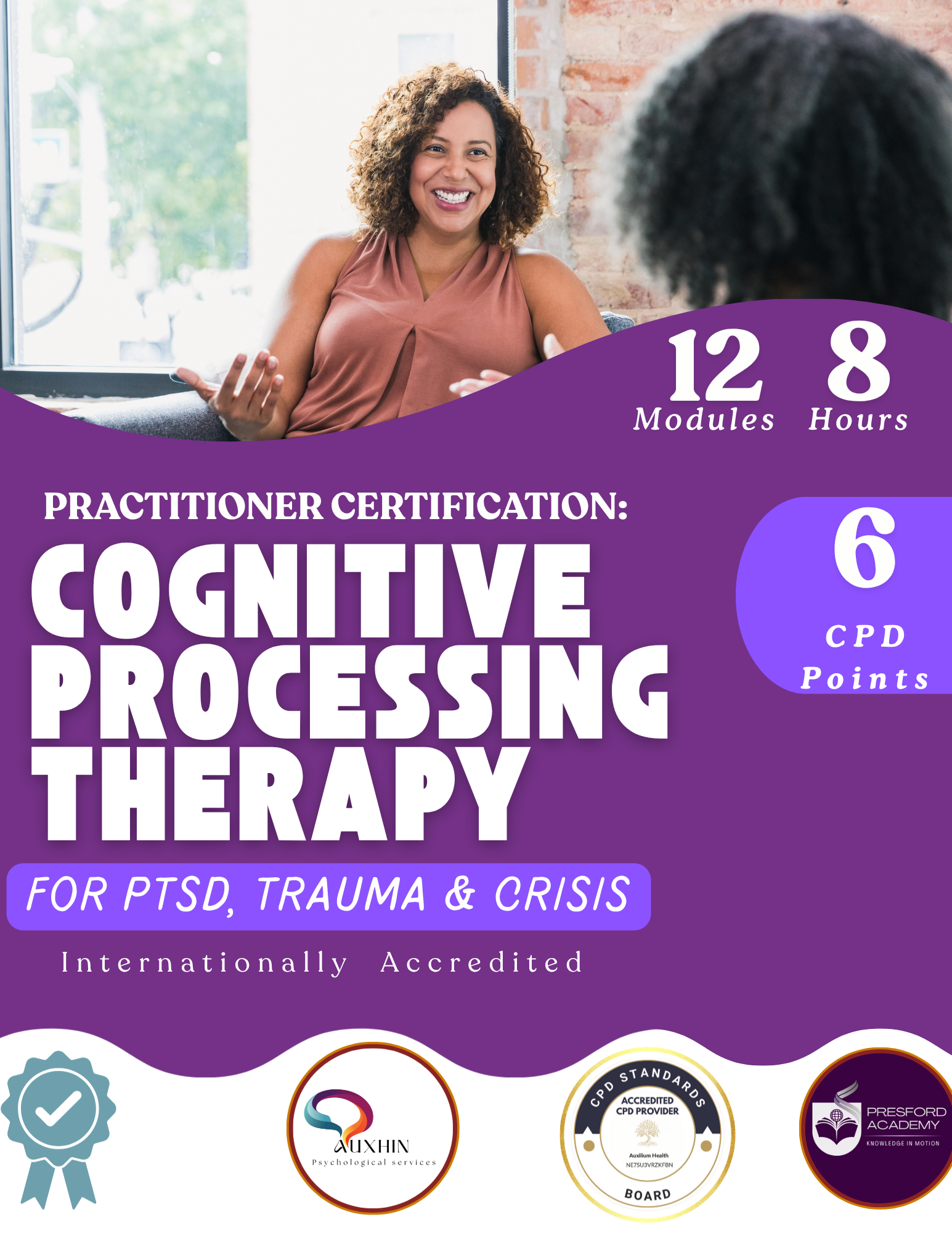
Cognitive Processing Therapy (CPT) for PTSD: Trauma & Crisis – Comprehensive Online Course
This 8-hour online course offers a complete, practical, and evidence-based guide to Cognitive Processing Therapy (CPT) for Post-Traumatic Stress Disorder (PTSD). Drawing from the latest clinical guidelines and the official CPT Therapist Manual, Second Edition, this course equips clinicians, trainees, and mental health professionals with the skills to confidently apply CPT across diverse client populations, including those with complex trauma and co-occurring conditions.
Through a structured, session-by-session approach, you will master the core principles of CPT, including identifying trauma-related “Stuck Points,” applying techniques such as Trauma Accounts, ABC Worksheets, and Socratic Dialogue, and addressing key themes of Safety, Trust, Power/Control, Esteem, and Intimacy. You will also gain practical strategies for adapting CPT to clients with multiple or prolonged traumas, integrating treatment with co-occurring disorders, and ensuring your own professional well-being.
Interactive exercises, quizzes, and case-based assignments provide hands-on practice, reinforcing your ability to conceptualize cases, develop targeted treatment plans, and facilitate meaningful client change. By the end of the course, you will confidently guide clients through the CPT process, helping them process trauma, challenge maladaptive beliefs, and build resilience.
Earn your certificate of completion and join a growing community of clinicians committed to delivering high-quality, evidence-based trauma care. Whether you are a student, psychotherapist, counselor, psychologist, social worker, or psychiatrist, this course empowers you to transform your clinical practice and make a profound difference in the lives of trauma survivors.
-
1
 Module 1: Introduction to CPT and the Theoretical Framework
Module One provides a foundational understanding of Cognitive Processing Therapy (CPT) as an evidence-based, structured therapy. You will learn the basic principles of CPT, exploring the core concept of PTSD as a "disorder of non-recovery" maintained by distorted beliefs. The module introduces the Cognitive Model of PTSD, detailing how trauma shatters core beliefs in the five key themes (Safety, Trust, Power/Control, Esteem, and Intimacy), and explains the role of "Stuck Points", specific, trauma-related thoughts, in preventing emotional processing and recovery.
-
2
 Quiz: Module 1 Knowledge CheckModule 1 Knowledge Check
 -
3
Module 2: The Initial Sessions and The Written Trauma Account
This module covers pre-treatment assessments and the first key CPT assignment: the written trauma account. Learners explore how to use the PTSD Checklist for DSM-5 (PCL-5) and how writing about the trauma helps clients face avoidance and identify “Stuck Points.”
-
4
Quiz: Module 2 Knowledge Check
-
5
Module 3: Processing the Trauma Account (Part 1)
Module Three focuses on the critical step of having the client read their written trauma account aloud. This serves as a controlled form of exposure and verbalization, which helps reduce the emotional intensity of the memory. The module emphasizes the therapist's role as a non-judgmental witness, focusing on active listening to identify initial "Stuck Points" in real-time. Crucially, the therapist's task during this session is to provide support and validation and note the Stuck Points, avoiding direct challenges during the reading itself.
-
6
Quiz: Module 3
Overall Learning Objectives
By the end of this course, learners will be able to:
-
Understand the theoretical framework and core principles of Cognitive Processing Therapy (CPT).
-
Conduct structured assessments and guide clients through written trauma accounts and impact statements.
-
Identify and challenge “Stuck Points” using Socratic Dialogue and the ABC Worksheet.
-
Apply CPT techniques to address trauma-related themes of Safety, Trust, Power/Control, Esteem, and Intimacy.
-
Adapt CPT for complex trauma and co-occurring disorders such as depression or substance use.
-
Develop case conceptualizations and evidence-based treatment plans.
-
aintain professional self-care and ethical boundaries when working with trauma survivors.
What You’ll Learn
- The full CPT model from assessment to intervention.
-
How to identify and restructure trauma-related beliefs (“Stuck Points”).
-
Techniques including Trauma Accounts, Impact Statements, ABC Worksheets, and Socratic Dialogue.
-
How to navigate the five core trauma themes: Safety, Trust, Power/Control, Esteem, and Intimacy.
-
Strategies for treating complex trauma and co-occurring conditions.
-
Practical guidance for treatment planning, documentation, and therapist well-being.
-
Confidence to deliver CPT effectively and ethically in clinical settings.
This course is ideal for:
-
Licensed mental health professionals (psychologists, counselors, therapists, social workers, psychiatrists).
-
Graduate students or trainees in psychology, counseling, or social work.
-
Professionals working in trauma, crisis intervention, or mental health care.
-
Practitioners seeking evidence-based skills for treating PTSD and trauma-related disorders.
-
Clinicians interested in integrating CPT into their therapeutic practice.
